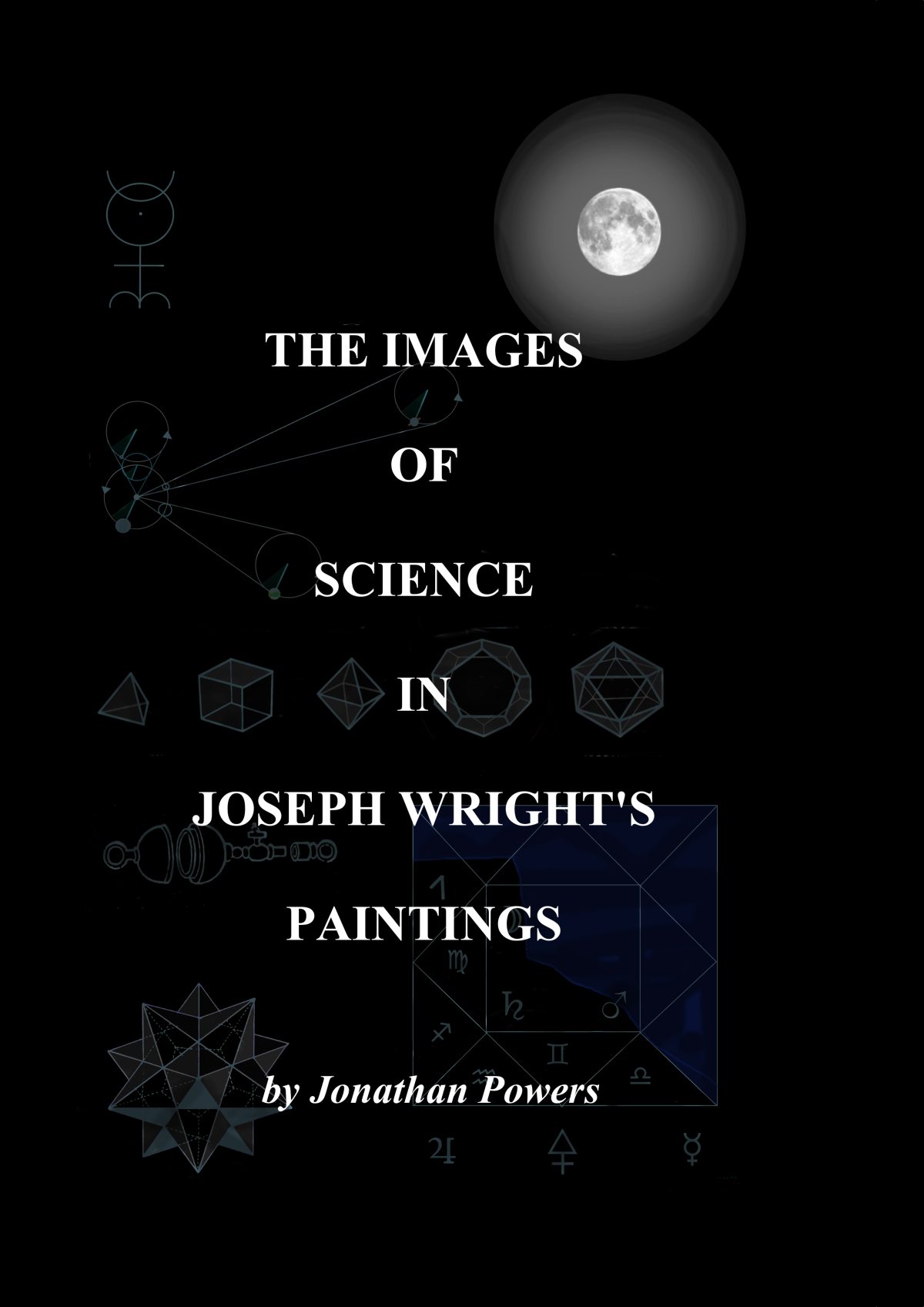
This book was written to mark the major Joseph Wright Exhibition, From the Shadows, at the Derby Museum and Art Gallery in 2026. This afforded a unique opportunity to see many of Wright’s paintings alongside one another – including A Philosopher giving that Lecture on the Orrery in which a Lamp is put in place of the Sun from 1766, alongside the even larger An Experiment on a Bird in the Air-Pump from 1768. The latter was shown adjacent to the cut-down remnant of a preliminary sketch for the painting, which is on the back of the canvas Wright reused for a dramatic self-portrait of himself dressed in ‘Turkish fashion’. An adjacent room of the Gallery showed the mezzotints of both of them as well as that for Wright’s third ‘scientific painting’, The Alchymist in search of the Philosopher’s Stone, discovers Phosphorus, with the original painting also hung in the same room.
The Exhibition provided the opportunity for the author to revisit his earlier monographs on these paintings, and to relate them to a narrative about the influence of Wright’s friend, Peter Perez Burdett, who clearly played a significant role in the creation of all three of them.
Though this book is primarily concerned with ‘the Orrery’ and ‘the Air-Pump’ (to use their short titles) there are also discussions of the scientific accuracy of elements in A Hermit studying Anatomy (1769), his portrait of John Whitehurst (1783), and William and Margaret (1785). There is only one new thing to be said about ‘The Alchymist’ and this is contained in a fourth Appendix in the new edition of the author’s Searching for the Philosopher’s Stone.
Peter Perez Burdett enters the story via his relationship with Washington Shirley (Earl Ferrers) and their efforts, together with John Whitehurst, to track the Transit of Venus on 6th July 1761, for which Ferrers was elected an FRS. The link between this and Burdett’s choreographing of ‘the Orrery’ painting suggests it could be subtitled “The Speed of Light”. The arguments about the identities of the participants are critically reviewed. With one minor amendment the previous likely identities are reaffirmed, with additional circumstantial evidence supporting John Arden as ‘the Philosopher’ thanks to further family portraits from three different lines of direct descendants. An Appendix explores the current reliability of face-recognition technology applied to portraits.
Peter Perez Burdett is also identified in ‘the Air-Pump’ alongside his wife’s companion (and his future mistress). The eventual purchaser Dr Benjamin Bates is argued to be the medical man timing the experiment. The significance of the differences between the Sketch and the final painting are discussed, and it is suggested it could be subtitled ‘Resurrection after Temporary Death’ – which might alter the way we look at the painting. Explanations of other elements in the painting are explored. Doubts are raised about whether anyone constructed air-pumps with an elevated ‘receiver’ capped with a hatch, and it is suggested this element was contrived to enhance the drama. Though there are indications that the location was a Palladian mansion at a significant distance from a Church Tower, which is scarcely visible in the painting, extensive searches have failed to reveal a plausible alternative to the hypothetical location previously suggested. The Sketch shows the lecturer dressed ‘Banyan’ fashion with a turban. While many such lecturers used a ‘lungs-glass’ rather than a living creature to illustrate the effects of being asphyxiated in a vacuum, John Arden showed the substitution was invalid.
One conclusion of the book is that Wright paid meticulous attention to tiny details in these pictures, the significance of which has often been overlooked (or misinterpreted).
Published by Quandary Books 2026 ISBN 978-913253-08-0
Pages: viii, 155 with numerous b/w and coloured illustrations